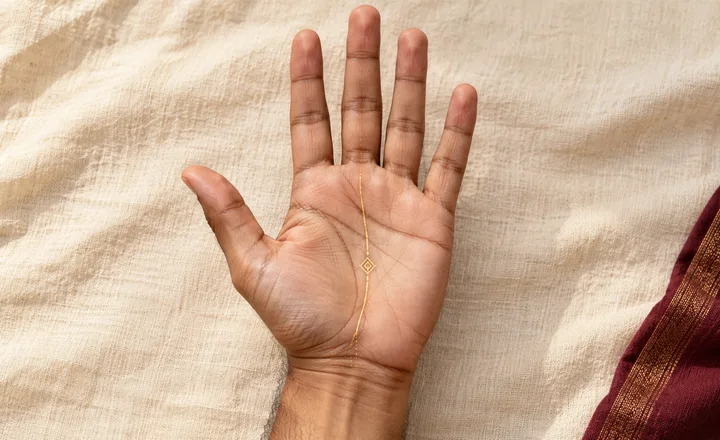
Where is the career line in your palm?
The career line, often called the fate or Saturn line, is a roughly vertical crease near the centre of the palm. Traditional palmistry associates its direction and appearance with work, responsibility and changing influences. Begin by locating the visible feature, then consider its symbolism alongside the wider hand. The most useful reading connects those themes with your own working experience.
First, career line and fate line usually mean the same thing
Searching “job line in hand” can be confusing because websites use different names for the same feature. Many call the central vertical line the career line, destiny line, fate line or Saturn line. A reader should explain which crease they mean before offering an interpretation. Otherwise, two readings may sound contradictory simply because their labels differ.
The fate line is different from the head line, which usually travels across the middle of the palm. Traditional readings discuss these together: one supplies a symbolic theme of direction, the other a theme of thinking. Neither is an aptitude test.
How to find the line without forcing a match
- Open your hand gently, with fingers naturally separated.
- Locate the middle finger and imagine a path down towards the wrist.
- Look for a vertical crease in or near the centre of that path.
- Follow only what is actually visible; the line may start halfway up the palm.
- Compare with the other hand in similar lighting.
Do not join unrelated tiny marks just to create a continuous line. A shadow can resemble a crease, and a line may become clearer when you relax your fingers. A useful photo includes the complete palm and wrist, taken straight on in bright, even light.
What common patterns traditionally represent
Here is how common visible patterns are usually discussed within the tradition.
| Visible pattern | Traditional theme | Useful reflection |
|---|---|---|
| Clear, fairly continuous line | Focus and continuity | What helps you maintain effort? |
| Line beginning higher in the palm | Direction developing over time | Which recent experience clarified your goals? |
| Visible change in direction | Changing priorities | What would you like to change about your work? |
| Branch or parallel segment | More than one influence | Are you balancing several interests? |
| Faint or unclear line | Limited basis for interpretation | What can be observed elsewhere without guessing? |
A faint line means there is less visual detail to discuss in that area. A reading can still explore other clearly visible features, including the head line, hand shape and finger proportions.
Does a broken career line mean job loss?
No. In traditional palmistry, an interruption may be discussed as a symbol of transition. That does not establish redundancy, failure or a particular year of change. Real careers include promotions, parental leave, education, relocation, caregiving and changes of interest. A crease cannot identify which of these applies.
Before worrying about a “break,” check the photo. A pale section, crossing crease or bright reflection may interrupt the appearance of a line without being a distinct feature. If it remains unclear, the correct observation is uncertainty.
Our fate-line guide explains variations in more detail. For an actual decision about leaving work, use the questions in Should I Change My Job?.
Can palmistry tell me which job to choose?
Palmistry offers a traditional discussion of tendencies rather than a list of job titles. A theme such as persistence can appear in teaching, operations, design, sales and many other roles. Compare it with the responsibilities you have enjoyed and performed well.
Use the reading as a prompt, then compare it with evidence from your life:
- Which tasks have you completed well, repeatedly?
- What do colleagues ask your help with?
- Which work gives you energy, and which work exhausts you?
- What skills do your target roles actually require?
- What constraints matter now: location, working hours or stability?
Write down examples rather than only adjectives. “I managed a difficult project” is more useful than “I am a leader.” This makes reflection concrete without pretending the palm chose your career.
Which hand should you upload?
Start with your dominant hand because it is the site's required image; the other hand can provide additional visual context. Different palmistry traditions use different hand conventions. There is no universal rule that every man must use the right hand and every woman the left.
Keep career timing separate from a palm overview
If your question is “naukri kab milegi?”, read our explanation of career timing in traditional astrology. It describes a different interpretive system and its limitations. Combining several traditions does not make an employment date certain.
Read the line in three simple stages
First locate it, then describe it, then interpret it. This order keeps the reading easy to follow. An observation might say that a central crease starts above the wrist and continues towards the middle finger. A traditional interpretation then discusses continuity or direction. Your reflection comes next: where does that theme fit your experience?
Avoid starting with an adjective such as “successful”. It hides the reasoning. Instead ask what was visible and why the reader connected it with a particular theme. You should be able to follow the explanation without knowing palmistry terminology.
The surrounding features provide context. A traditional reading may discuss the head line for thinking style or finger proportions for broader tendencies. Those details should each be visible and explained separately before they are brought into a connected interpretation.
Make career reflection specific
Choose a project or responsibility from the past year. What did you enjoy about it? What helped you complete it? Which part would you like to do more often? Comparing a palm theme with a real example is more useful than collecting flattering personality words.
If the interpretation mentions focus, identify what supports your focus: clear goals, a good team, quiet work or visible progress. If it mentions changing direction, consider whether your priorities have already shifted. You can then use the reading as a starting point for a better conversation about your work.
Questions you may have
Is the career line different from the fate line?
Usually these are two names for the same central vertical line. Some readers use the terms differently, so ask which visible feature their explanation refers to.
What if I have no visible career line?
It does not mean you will be unemployed or unsuccessful. The crease may be faint, absent or unclear in the photo. A reading should acknowledge that limit rather than invent a feature.
Can it predict my salary or next job date?
No reliable salary or employment date can be established from a palm line. Treat traditional meanings as reflection and base job decisions on skills, opportunities and your circumstances.
Sources & reading notes
These sources explain the traditions discussed in this guide. The article is educational; a personal reading considers your own details.
- Cheiro, Palmistry for All (1916) ↗Historical primary source for palmistry terminology. Its predictive claims and outdated stereotypes are beliefs, not scientific evidence; REKHAA does not endorse them.
REKHAA offers AI-generated traditional interpretations for entertainment and self-reflection. These practices are not scientifically validated and cannot replace medical, financial, legal or other professional advice.