What does the fate line mean?
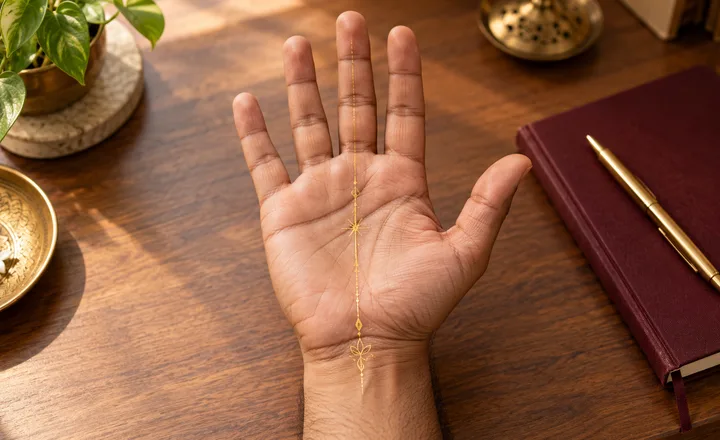
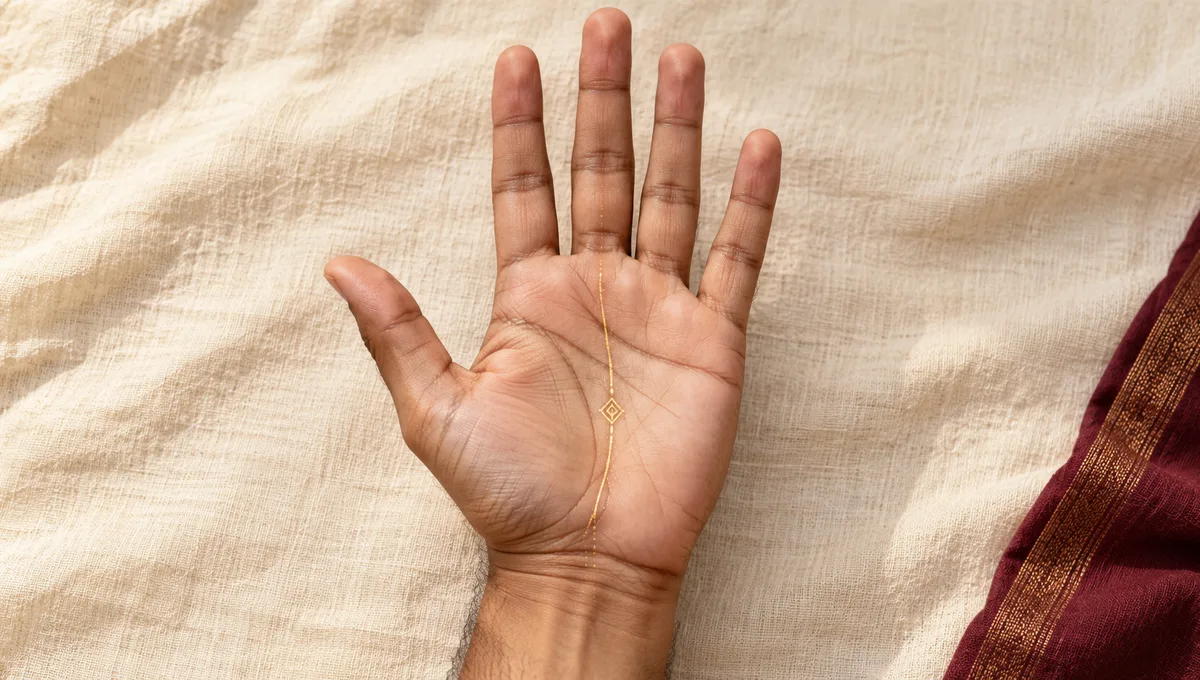
In traditional palmistry, the fate line is a roughly vertical crease in the central palm, often directed towards the middle finger. It is also called the career or destiny line. Readers associate its appearance with direction, responsibilities and changing influences. Begin with its visible course, then consider the traditional theme alongside your own experience of continuity, choice and change.
Begin with the visible course of the line
The word “fate” can make this line sound more powerful than it is. A person looking for reassurance may see one broken section and worry that their career or relationships will collapse. A useful reading begins with a description: where a crease starts, which direction it takes, and which portions are clear. Only then does it explain the traditional association. Keeping those steps separate makes it easier to understand what was observed and what was interpreted.
Where to look for the fate line
Relax the hand and look through the centre of the palm towards the middle finger. The line may rise from near the wrist, from one side, or from higher within the palm. It may be continuous, segmented or difficult to distinguish.
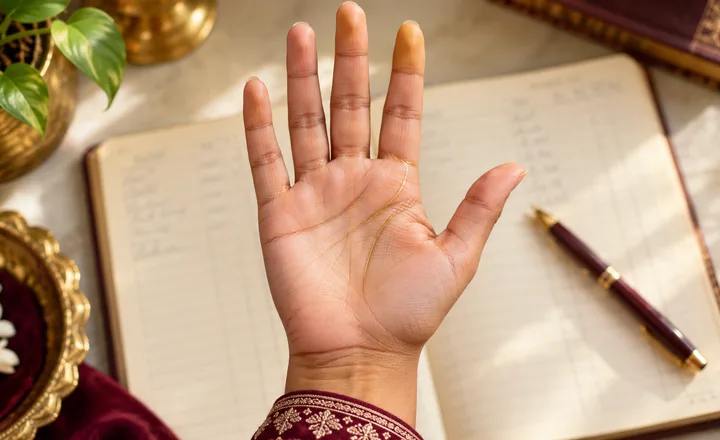
Do not confuse it with the life line curving around the thumb, the head line across the middle of the palm, or the heart line below the fingers. Those names describe different traditional features. A hand does not need to match a textbook illustration to be normal.
Career line, destiny line and Saturn line
These terms often refer to the same feature. The name Saturn comes from the traditional association of the middle-finger area with Saturn; it does not mean a planet created the crease or caused a particular event.
Our career-line article focuses on work-related reflection. This article focuses on how the visible variations are discussed and why they should not be turned into fixed timelines.
Common variations and their limits
| Pattern a reader may observe | Traditional theme sometimes discussed | Important limit |
|---|---|---|
| Relatively continuous line | Continuity of direction | Does not guarantee a stable career |
| Line beginning higher up | Direction emerging gradually | Does not establish the age of success |
| Interrupted appearance | Transition or changing influence | Does not predict job loss |
| Branching feature | Different interests or influences | Does not count employers or businesses |
| Faint or absent line | Less emphasis on this symbol | Does not measure motivation or worth |
Line appearance and personal experience can differ. Use the table as an introduction to traditional symbolism, then explore which themes fit your own story. ## What does a broken fate line mean?
Historically, readers have attached change-related meanings to interruptions. A cautious contemporary reading can describe that association without predicting the event, its date or its consequences.
First check whether the break is genuinely visible. A crossing line may interrupt the viewer's attention. Uneven lighting may wash out one section. A slight bend of the hand can change how a crease appears. Looking at the original image is more useful than enlarging it until compression artefacts resemble detail.
If an interruption is clear, you can use the change theme to reflect on transitions you have actually experienced. What helped you adapt? What would you do differently next time? That is a practical use of symbolism without treating it as advance notice of a crisis.
Does having no fate line mean no success?
No. This is one of the most harmful shortcuts in palm-reading content. The absence of a visible feature does not establish unemployment, lack of purpose or a difficult future. It may simply provide less material for that section of the reading.
A good report can say that clearly and discuss other visible characteristics. It should not invent a faint line to avoid disappointing the user, nor should it fill the gap with a negative prediction.
Can a fate line tell an exact age?
Traditional books sometimes place ages at different points along palm lines. These are interpretive schemes, and readers may apply them differently. There is no reliable basis for converting a photograph into a guaranteed promotion at 35 or a career crisis at 42.
If you are interested in timing symbolism from another tradition, see career timing in Vedic astrology. That tradition uses birth details and planetary periods rather than hand features.
Look beyond one line without overclaiming
A reading may discuss hand shape, finger proportions and other creases alongside the fate line. That can make the interpretation more connected, provided each visual observation is actually supported by the photograph.
Do not turn a collection of uncertain observations into a confident conclusion. Five faint marks are still five uncertain marks. The money-line guide shows why naming a crease is important, while foreign-travel symbolism explains why movement themes do not establish a visa or destination.
Follow the visible course in stages
Start at the lowest clearly visible point and follow the crease upwards. Note where it becomes stronger, fades, changes direction or meets another line. Describe these details without joining unrelated marks. This creates a useful observation even when the entire line is not continuous.
Then ask which traditional theme the reader attaches to the variation. Continuity, emerging direction and changing influences are broad ideas. A clear explanation connects the theme with the visible feature before asking you to reflect on it.
Compare both hands in similar lighting if you want differences discussed. Changing angle or stretching one hand can make a photo comparison misleading. Keep the images as comparable as possible so the reading focuses on the hand rather than the camera conditions.
Explore direction through your own experience
Think about a time when your priorities became clearer. Was it a project, a conversation, a difficult period or a new responsibility? What did you learn about the work or life you wanted? These questions make “direction” a personal subject rather than an abstract destiny label.
You can also consider what stayed consistent through changes: a skill, a value, a relationship or a preferred way of working. Traditional fate-line themes can provide a starting point for that reflection. The interesting story is how you recognise and shape those patterns in your own life.
Questions you may have
Is the fate line the life line?
No. The fate line is usually more vertical in the central palm; the life line curves around the thumb. Neither should be used to predict death, lifespan or health.
Does a broken fate line mean my career will fail?
No. Traditional transition symbolism does not establish failure or job loss. Check image quality first, then treat any interpretation as reflection rather than a forecast.
Can the fate line change my destiny?
A crease does not determine your destiny. Palmistry offers traditional symbolic interpretations; your decisions, opportunities and circumstances remain central to your actual life.
Sources & reading notes
These sources explain the traditions discussed in this guide. The article is educational; a personal reading considers your own details.
- Cheiro, Palmistry for All (1916) ↗Historical primary source for palmistry terminology. Its predictive claims and outdated stereotypes are beliefs, not scientific evidence; REKHAA does not endorse them.
REKHAA offers AI-generated traditional interpretations for entertainment and self-reflection. These practices are not scientifically validated and cannot replace medical, financial, legal or other professional advice.