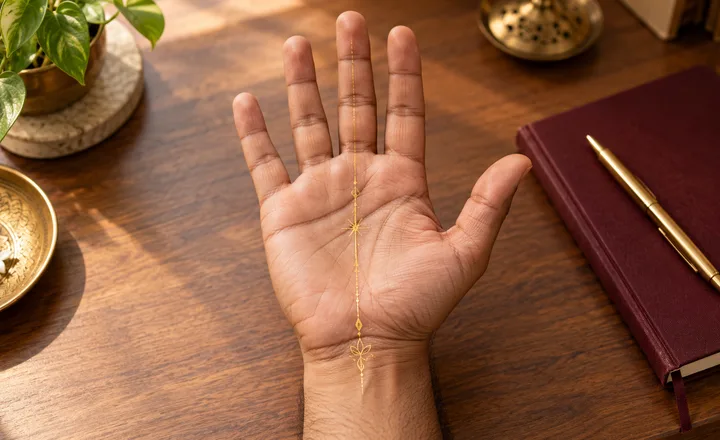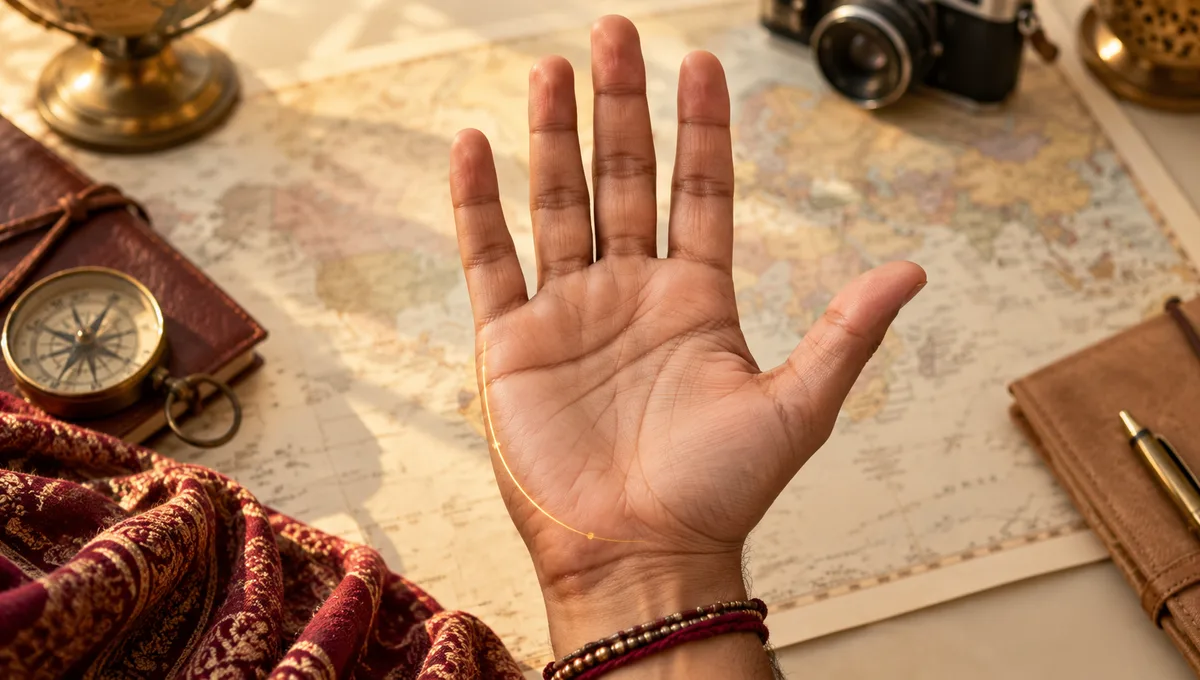
Where are travel lines traditionally located?
Palmistry traditions often discuss fine marks on the lower outer palm, known as the Moon or Luna area, and outward branches from the life line as travel symbols. Their appearance is interpreted through themes of movement, unfamiliar environments and changing surroundings. Start with a clear photo and distinguish visible features from their traditional meaning, then relate the themes to the kind of travel you want.
Travel, an overseas job and settlement are different questions
A short holiday, a degree overseas and permanent relocation involve very different commitments. Search results for “videsh jane ki rekha” sometimes group all three under one label. That makes a reading sound clearer than it really is.
Before looking at your hand, name the actual question. Are you curious about exploring new places, changing your working environment, or building a life elsewhere? Define the goal clearly so a discussion of movement relates to the kind of change you actually want.
Two areas commonly discussed in palmistry
The lower outer side of the palm, towards the wrist and opposite the thumb, is traditionally called the Moon or Luna area. Fine horizontal or slanting marks here are sometimes discussed as travel lines.
Another feature readers may mention is a branch moving outward from the life line. The life line is the major curve around the base of the thumb. Here the discussion concerns the direction of the branch and its traditional movement symbolism; the life line is not used to assess health or lifespan.
The locations are traditional labels. Readers disagree about significance, timing and which marks deserve attention. A tiny skin fold should not become a travel prediction simply because it is near the expected area.
How to check a photo carefully
- Include the wrist and lower outer edge rather than cropping tightly.
- Keep the palm flat but relaxed; do not stretch the skin hard.
- Use even daylight or a well-lit room without a direct glare.
- Take the picture straight on and check it before uploading.
- If small marks remain unclear, leave them unclassified.
Photo quality matters particularly here because alleged travel lines are often finer than the major palm creases. A phone's sharpening or shadow can create the impression of a feature. AI should not label “three foreign journeys” when it only sees three faint marks.
What the symbols can mean as reflection
Instead of treating each line as a ticket abroad, use the traditional theme of movement to ask more useful questions. Are you drawn to unfamiliar environments? Does variety matter in your work? Are you considering a move because it suits your goals, or because you feel stuck where you are?
| Question | What a palm reading may offer | What needs real-world evidence |
|---|---|---|
| Am I interested in change? | A symbolic theme to reflect on | Your experiences and preferences |
| Will I get an overseas job? | No reliable confirmation | Employer demand, applications and eligibility |
| Which country suits me? | No reliable destination | Language, roles, costs and personal needs |
| Will I settle permanently? | No reliable promise | Official immigration rules and your decisions |
The table separates movement symbolism from travel planning. A good explanation identifies the visible feature, names the traditional theme and relates it to your interests.
Why a missing travel line is not a restriction
If you cannot find a mark in these areas, it does not mean you are destined to remain in your birthplace. Many people travel despite having no obvious line that fits a diagram. Others have fine marks but no interest in moving.
Do not let an unclear image close off a goal you can investigate practically. Equally, a prominent mark should not replace preparation. Passport arrangements, suitable skills, job opportunities and family responsibilities remain relevant regardless of the reading.
Compare travel themes with the wider palm
A traditional reader may consider direction and ambition alongside travel symbolism. Our career-line explanation introduces those themes, while the fate-line guide explains why a change in a crease is not a fixed event on a timeline.
Looking at the wider palm creates context: how do movement, direction and curiosity fit together in the traditional reading? The explanation should show that connection clearly.
What if your question is about your birth chart?
Palmistry and Vedic astrology use different inputs. Palmistry looks at hand features; astrology interprets a calculated birth chart using birth details. Read foreign settlement yog in kundli and foreign-job astrology if that is the tradition you want to explore.
Read the location before reading the meaning
The Moon area sits opposite the thumb, towards the wrist. Find that area using the major palm creases for orientation rather than searching for a particular number of marks. Some fine lines become clearer when the hand is relaxed; others remain too faint for a useful description.
A reader should identify the location in ordinary words before discussing symbolism. “Fine slanting creases on the lower outer edge” is an observation you can check. “Movement and unfamiliar environments” is the traditional theme that follows. Keeping those parts separate makes the reading easier to understand.
An outward branch and a fine crease are different observations. They should not be treated as interchangeable merely because both appear in travel diagrams. Ask which feature the explanation refers to and whether it is clearly visible in your original photo.
Connect the movement theme with what you want
Think about a place where you felt comfortable despite being outside your usual surroundings. What helped you settle in? Was it language, people, work or the chance to explore? That experience can tell you what kind of travel environment you enjoy.
Then identify the purpose of your next move: learning, work, family connection or a change of routine. Write one practical question you need to answer before planning further. A palmistry theme becomes more interesting when it helps you describe your preferences, rather than simply collecting symbols labelled “abroad”.
Questions you may have
Can my palm show which country I will move to?
No reliable country or destination can be identified from palm creases. Traditional travel symbolism does not establish a visa category, location or immigration outcome.
Is the foreign travel line the same as the life line?
No. Readers may discuss a branch from the life line or fine marks on the lower outer palm. Neither provides a validated prediction of foreign travel.
Will REKHAA invent travel lines if my photo is unclear?
It should describe only features that are visible. If the lower palm is blurred, shadowed or cropped, the observation should acknowledge that limitation.
Sources & reading notes
These sources explain the traditions discussed in this guide. The article is educational; a personal reading considers your own details.
- Cheiro, Palmistry for All (1916) ↗Historical primary source for palmistry terminology. Its predictive claims and outdated stereotypes are beliefs, not scientific evidence; REKHAA does not endorse them.
REKHAA offers AI-generated traditional interpretations for entertainment and self-reflection. These practices are not scientifically validated and cannot replace medical, financial, legal or other professional advice.