Where is the marriage line in a female hand?
The marks commonly called marriage or relationship lines are small creases on the outer edge below the little finger, above the heart line. They are found in the same general area on women and men. Traditional palmistry discusses their appearance as relationship symbolism. A useful reading describes the visible marks and connects them with reflection about emotional connection and commitment.
Why people search for a female marriage line
“Meri shaadi kab hogi?” is often a question about uncertainty, family expectations or a relationship that is not moving forward. But the phrase “marriage line in female hand” can hide two assumptions: that women need a different method, and that one crease contains a complete relationship timeline.
Neither assumption is a reliable basis for making personal decisions. Palmistry is a traditional interpretive practice. Its symbols can be interesting, but your consent, compatibility and communication matter more than whether a mark matches a diagram.
Finding the correct area
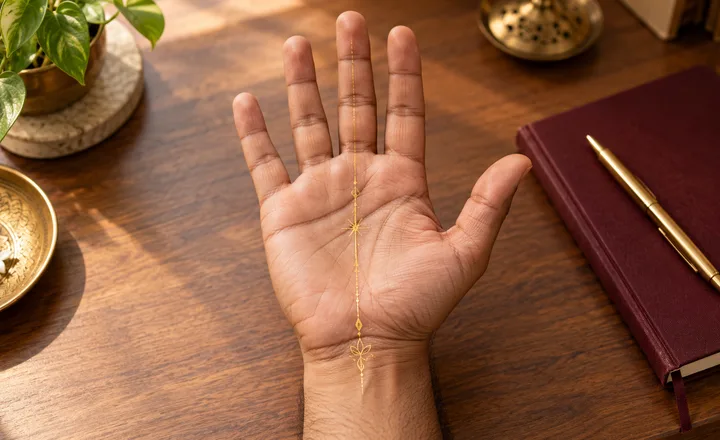
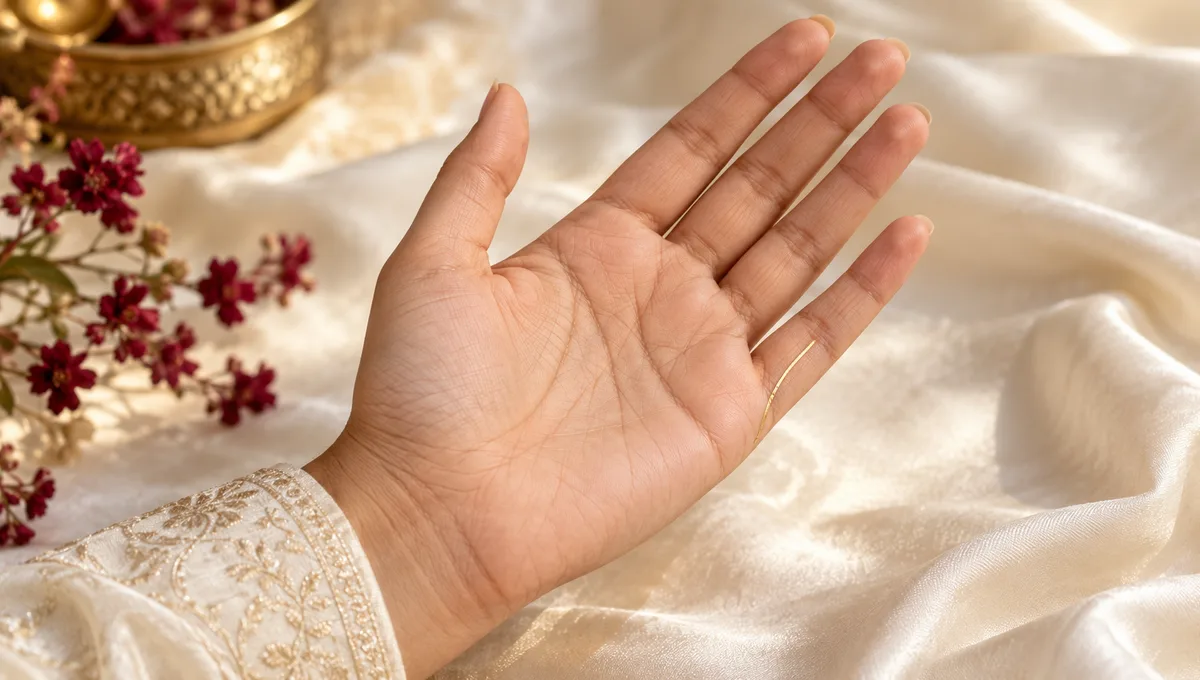
Begin with an open, relaxed hand. The heart line is usually the upper major crease running across the palm below the fingers. The area people call the marriage-line area is on the little-finger side, between that crease and the base of the little finger.
These small marks may be more visible from the side than in a straight-on photograph. Do not confuse them with wrinkles around the finger joint. Some people have several short creases; some have one clearer mark; others have no easily visible line.
A simple check:
- Find the little finger.
- Look below its base along the outer edge of the hand.
- Identify the upper major heart-line crease for orientation.
- Observe only the smaller marks above that crease.
- Record what is visible, without converting the count into a spouse count.
The general palm photograph required for a reading may not show the outer edge in enough detail. In that case, an honest analysis should say the feature is unclear.
Left hand or right hand for women?
Traditions disagree. Some distinguish a dominant hand from the other hand; older books may assign different meanings using gendered conventions. These are conventions, not proven rules about women or men.
REKHAA asks for your dominant hand and recommends the other hand for context. This approach avoids assuming that every woman uses her left hand or that handedness reveals a relationship destiny. Photograph both in comparable light if you want visible differences discussed.
What traditional interpretations actually offer
A reader may discuss the prominence or direction of a small relationship crease alongside the heart line. Ask what theme is being described: emotional expression, expectations of connection or your approach to commitment.
| Observation | A cautious traditional discussion | What it does not establish |
|---|---|---|
| One prominent short crease | Importance attached to close connection | Exactly one marriage |
| Several fine marks | Different emotional influences | Multiple spouses or affairs |
| A fork-like ending | A theme of differing directions | Certain separation or divorce |
| A faint feature | Limited visibility | Inability to love or marry |
Use these associations to explore your own approach to connection. Another person's behaviour and intentions are best understood through real interaction and communication.
Can a marriage line show an exact age?
Some historical systems place ages along this area. Their scales differ, and a photograph introduces additional uncertainty. There is no reliable method here for promising a wedding at 27, 32 or another age.
If a prediction makes you feel late or behind, pause before treating it as a fact. Your relationship choices do not expire because an image was assigned a number. Read how traditional astrology approaches marriage timing for the chart factors and timing terminology used in that tradition.
What a helpful relationship reading should sound like
Compare these two approaches. “You have two lines, so you will marry twice” is an unsupported claim. “There are two visible fine creases in this area; traditions discuss such marks in relation to emotional influences, but they do not establish the number of marriages” keeps observation and interpretation separate.
From there, reflection can become practical. Do you feel able to state your needs? Are expectations about commitment shared? Are family preferences being discussed openly? These questions are useful whether or not a palmistry theme resonates.
For the difference between social expectations and personal choice, see love marriage or arranged marriage. Both paths depend on people, not just symbols.
Do not read one small line in isolation
Relationship interpretations often also discuss the heart line. A photo-based reading should describe that line only if it is visible. It should not compensate for an unclear edge by inventing detail elsewhere.
The career-line guide explains the same principle in another context: a visual observation is not proof of a life event. Apply that standard consistently across every section of a reading.
Look at the heart line as well as the outer edge
Small relationship creases provide only one part of a traditional palm discussion. The heart line is the larger crease below the fingers. Readers commonly associate its shape and course with emotional expression, then consider it alongside the rest of the hand. This creates a broader conversation than focusing on one tiny mark.
Start with a clear description. Is the heart line relatively straight or curved? Which sections can you follow in the photograph? Is the outer edge visible enough to discuss? A connected reading explains each observation before bringing the themes together.
For example, a traditional discussion of emotional openness may prompt you to consider how easily you express care or explain your needs. That reflection belongs to your experience; a line count does not describe another person's private thoughts.
Use the relationship theme in everyday life
Think about a recent conversation where you felt understood. What helped: a calm setting, direct words, time to listen or a clear request? Then consider a conversation that felt difficult. The comparison helps you identify what you want to improve.
If commitment is on your mind, list the expectations you want to discuss openly. These may concern time together, work, family involvement or personal space. A traditional reading can offer a prompt, but the useful next step is a conversation where both people can express their preferences and be heard.
Questions you may have
Which hand shows the marriage line for women?
There is no universal, scientifically supported female-hand rule. Traditions vary. Upload your dominant hand for REKHAA and the other hand if you want additional visual context.
Do two marriage lines mean two marriages?
No. Counting small creases cannot reliably establish the number of marriages, partners or affairs. A reading should not make relationship accusations from these marks.
Does a missing line mean I will never marry?
No. A feature may be absent, faint or hidden in the photograph. It does not determine your ability to form a relationship or your future marital status.
Sources & reading notes
These sources explain the traditions discussed in this guide. The article is educational; a personal reading considers your own details.
- Cheiro, Palmistry for All (1916) ↗Historical primary source for palmistry terminology. Its predictive claims and outdated stereotypes are beliefs, not scientific evidence; REKHAA does not endorse them.
REKHAA offers AI-generated traditional interpretations for entertainment and self-reflection. These practices are not scientifically validated and cannot replace medical, financial, legal or other professional advice.